Preserving the history of Brockenhurst - a wonderful village at the heart of the New Forest
Village Sports
Brockenhurst's clubs and organisations for sport
Brockenhurst has always punched above its weight (sic) in sports, and enjoys a wide range of clubs and sports activities, albeit fewer now than a few years ago. You can find about the village's non-sport groups and societies here.
Brockenhurst Cricket Club
The Brockenhurst Cricket Club was formed in or before 1797 and have been playing on the ground at Balmer Lawn for over 200 years. The first documented games (in 1797) were against Southampton and Portsmouth teams. One opening batsman was Edward Morant, Lord of the Manor of Brockenhurst, who played three first class matches. His son also regularly opened the batting for Hampshire in the 1840’s.
Three games against Minstead took place in 1867-8 and games against other Forest villages soon followed.
Permission was given by H.M. Office for Woods and Forests in 1894, for the current area of the pitch to be maintained as a cricket pitch because previously the ground had also been used as a golf course by the Bournemouth Golf Club.
‘Brusher’ Mills was the only ‘professional’ player to have played for the team because when they were a ‘man short’ he would be asked to play. He would agree to play only on receipt of half-crown, whence he would remove his jacket and two waistcoats and get down to playing. The payment was hidden from visiting teams!
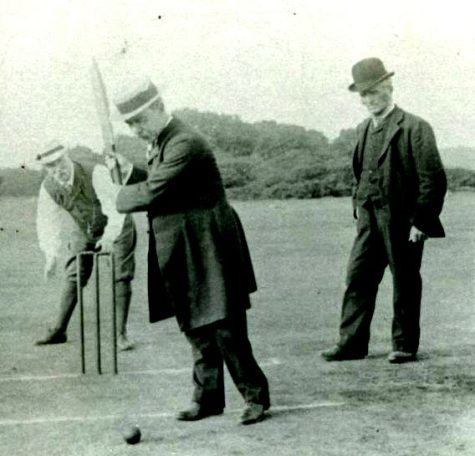
Margaret Plumbly, who lived in Partridge Road, wrote notes of the village in the 1940’s. She mentions that ‘the Toffs’ played cricket at Balmer Lawn, which included the Vicar, Parish Church clerk and other prominent members of the community. The village ‘Lads’ played where the Jubilee Oaks are on Lymington Road, now much reduced by road improvements in Church Lane and Lymington Road. Pictured, above left are Dr. Hibberd, Rev. Arthur Chambers & Frank Jenvey, at Balmer Lawn in the 1920's - a posed photograph!
About 30 people attended a meeting, in March 1925, presided over by the Vicar the Rev. E.H. Kennedy, to revive and improve the constitution of the cricket club. Colonel, the Hon. Malcolm Bowes-Lyon, of Whitley Ridge, was invited to become the President. Mr. Ainslie was elected chairman. Mr. F. Perkins MP became Secretary, Members would maintain the pitch by rota. It was also noted that the previous season’s income was £20.00. The Chairman said he hoped that they would have an attractive programme; enter a league; have a second team and erect a pavilion.
The following year, having entered the Bournemouth and District League, Brockenhurst came runners-up in the Second Division and were promoted. A celebration dinner was held at the Railway Inn (Snakecvatcher) attended by 80 guests.
1935 was another trophy winning season for the team who came top of Division One of the Bournemouth and District league. The team included three Waterman brothers as well as Jack Hull who played for the club for 50 consecutive years (until 1976) and was also the Club’s groundsman. In 1939 the team were one of three to top the league. The feat was repeated after the Second World War in 1951 when they won the league outright.
In 1947 the club was also a prime mover in the formation of the New Forest League. Brockenhurst Cricket Club won the New Forest Club Cricket Association League in 1995 and the New Forest Indoor Cricket League Division 2 in 2003. Thriving village cricket continues with adult and young teams playing at Balmer Lawn.
Brokenhurst Manor Golf Club
On the right of Sway Road, before the rail bridge, is the entrance to the Brokenhurst Manor Golf Club, retaining original village spelling.
In September 1912 the Estate Trustees proposed to layout a golf course of eighteen holes at Blackhamsley Farm. A golf course company was formed in 1913 and 150 acres of the farm was leased from the Morant family’s Brokenhurst estate.
Construction commenced the following year with an opening in September 1915. The popularity of the sport persuaded the railway to plan for a ‘halt’ on the Sway side of the bridge; the golf course went ahead but the halt did not. (At ‘halts’, trains could be flagged down, but did not stop automatically).
With the national food shortage in 1917 part of the course was ploughed for vegetables. In 1919, only sixteen holes were playable.
After the First World War, a clubhouse was designed by Capt. Cecil Sutton (the Morant’s Land Agent), using two wooden ward huts from the WW1 New Zealand Tile Barn Hospital. At Lymington Petty Sessions, the Club applied for a license to sell liquor. The application was opposed by the Police Superintendent on the grounds that the club house was an insecure wooden hut, the area was not easily policed, and there were sufficient licensed premises already in the village. The Magistrates rejected the objection and granted the license. The clubhouse opened in April 1920.
The Ryder Cup Team played on the course on 6 May 1931 as a warm-up for a forthcoming tour of the USA.
In January 1934, Brokenhurst Manor Golf Club had four players whose average height came to nearly 6 feet 5 inches; Capt Cecil Sutton, Mr F W Yateman, Mr R Ponsonby, Lieutenant Commander F E Wilmot-Sitwel and Mr George Spencer.
In August 1936 a small aircraft, with engine trouble, landed on the 9th fairway. The pilot had circled twice to disperse the golfers. After holding play for two hours, the pilot managed to get his engine going and took off for Bournemouth, without ever disclosing his identity.
To celebrate the club’s Silver Jubilee in 1939 a professional match, with prize money of £150, was played between Henry Cotton (Open champion 1934 and 1937) and Laurence Ayton, jnr. (Scottish International) against Reginald Whitcombe (Open champion) and Percy Alliss (Match Play champion 1933 and 1937).
The match was played over 36 holes, took place on Saturday 3 June 1939. There was drama! A slightly pulled drive by Henry Cotton to the thirteenth, hit a spectator 200 yards away full on the forehead. Cotton was concerned, but the victim of the mishap apologised for spoiling what might have been a good shot.
At the following ‘Silver Jubilee’ dinner, the Captain, Sir John Power MP, proposed that as the then Queen (Queen Elizabeth the late Queen Mother) had played golf the course (when she was the Lady Elizabeth Bowes-Lyon the family owned Whitley Ridge, now The Pig Hotel), the club should request that ‘Royal’ be added to its name. This had happened at the Lymington Yacht Club which had recently had ‘Royal’ added to its title. The club still waits!
In January 1951, the Morant Estate sold the land to the newly formed Brokenhurst Manor Golf Club Limited.
The club won the English and European Champion Club titles in 1988. Brokenhurst Manor Golf Club Male members won the England Champions Club title in 2007. The current Course Record is 63 (-7), jointly held by members Martin Young and Richard Bland, who both play on the European Tour and professional Justin Rose.
Brockenhurst Football Club – the ‘Badgers’
The Brockenhurst Football Club was founded in 1898 initially playing on a field near Rhinefield Ornamental Drive, courtesy of the Walker-Munro family. Their first proper pitch was behind the Baptist Chapel on Lyndhurst Road. They moved before the first World War to a site between the Rose and Crown and Snakecatcher pubs.
After Lyndhurst Road, the club relocated to a field in Wide Lane (Sway Road), then after the First World War to the Polo Field (now College grounds). In the late 1920’s they moved to Fathers Field until 1931 when the land was needed to build council houses. Then the club moved to a field at Black Knoll House, but this required changing play to the open forest towards the end of each season to allow the grass to recover.
In 1935 the club won the New Forest Lads Cup. Within two years the Badgers moved to Oberfield and after the Second World war they spent some seasons at Tile Barn.
In May 1950, the club bought land on Grigg Lane from the Brockenhurst Estate, for £630. Prior to 1940, this was a playing field for the Church of England School. The first games were played here in 1951.
The purchase included both the present ground and additional land adjoining Fathers Field. The Club then sold this to the New Forest Rural District Council, for £456, to enable the building of the newer houses in Fathers Field and Horlock Road. The proceeds were used to provide a well-drained pitch and other facilities.
The draining of the ground involved diverting a ditch for 40 yards and, in forest tradition this had been lined with a row of large oak trees, which later needed to be felled to provide room for a club house and stand. The Supporters Club raised the funds for the materials to enable club members to provide the labour by the beginning of May 1952.
The club were crowned Hampshire League Division Three champions in 1960 as well as winning the Bournemouth Seniors cup. They moved between the Second and Third divisions until in 1971 they were promoted to Division One where they won the league title in the 1975-76 season. A thriving Social Club was established in 1972. Excavations for a new stand commenced in 1975 which was formally opened on 23 August 1977 with seating for 200 people, above the two changing rooms for the teams, equipped with showers.
The club was a founding member of the New Forest league and in 1986 Brockenhurst were founder members of the Wessex League. The club’s FA Cup giant killing reached its pinnacle in season 2001/02 when Kingstonian FC were defeated and in season 2004/05 the club reached the 3rd qualifying round, the run ending in defeat to Bath City.
In 2013, Brockenhurst and Andover Town set a new record as they scored 29 consecutive penalties in a shoot-out. The Hampshire Senior Cup match finished 0-0 after extra time, so went to spot-kicks. After 29 successful attempts - a total confirmed by the Football Association as an English record – Andover missed, giving victory to Brockenhurst, 15 penalties to 14.
In the 2019-20 Season Brockenhurst FC won the Bournemouth Senior Cup and the following year won the Hampshire FA Invitation Trophy as well as both the Under-18 and Under-17 teams winning their divisions.
Brockenhurst Bowling Club
In the first quarter of the twentieth century, the gentlemen of the village gathered for informal bowls contests. The venue was a bowling green in the grounds of ‘Carey’s’, owned by Herman Bowden-Smith. The green was also used for village fund-raising events organised by Mr and Mrs Bowden-Smith, such as for the British legion in 1930.
This became more established (but the players only competed against each other) until Mr Bowden-Smith died in 1932. For a couple of years the green remained, but the players were forced to move in 1936, when Carey’s was sold and became a hotel, Carey’s Manor.
Cecil Sutton, the land agent for the Brokenhurst Manor Estate owned by John Morant, took sport seriously (he was otherwise involved in both the Tennis and Football Clubs) and offered a patch of land at the far end of a field behind Brookley Road, near the Football Ground. A peppercorn rent of £2.00 each year was agreed, with the estate having to cut and maintain the lawn. This more permanent arrangement enabled the creation of a formal Brockenhurst Bowling Club, with John Morant as its President. In its first year it played against Lymington and Lyndhurst Clubs.
In the winter of 1936/1937 a new green was laid which improved play considerably on the new site, and by 1939 there were 50 members. Also in 1939 the first ‘Social Club for Ladies’ was appointed by the committee. The highlight of pre-war years was play between members for The Morant Cup. Play continued through the war.
In 1950, the Brokenhurst Manor Estate needed to raise funds to pay tax bills, and offered the ground for sale to the Bowling Club, at the same time as the Football Club bought its ground. £500.00 (at a rate of four per cent) was raised through a bank loan, guaranteed by eight of the bowling club members. The club also insisted on buying the field next door.
This had been used for some of the year by the village butchers to raise Christmas Turkeys. The club was worried that if poultry became a permanent feature their pecking would encourage worms – which in turn would migrate and damage the adjacent bowling green. (Later the Rural District Council bought most of the field which is now the village car park – a small section was sold to the Scouts and their first hut was here next to the Bowling Green, now houses).
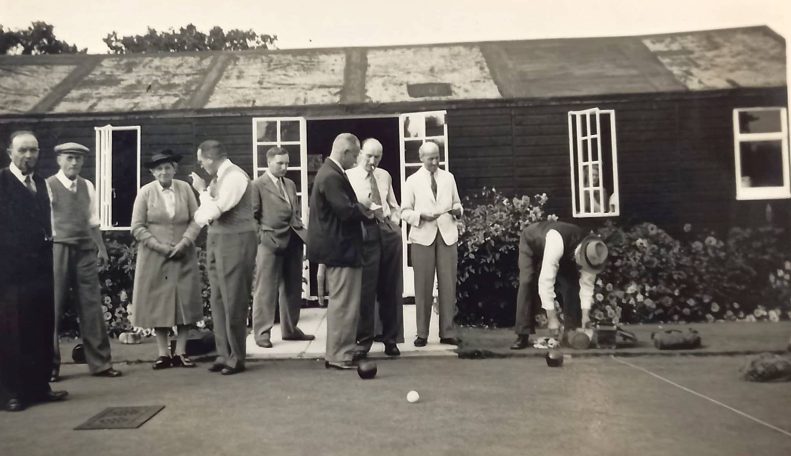
Until 1945, the club used the Scouts Hut as its pavilion. At the end of the war an army surplus hut was bought for £20.00. However moving and erecting the hut cost £58.16s, and so the subscription had to be raised from ten shillings a year to fifteen shillings. The picture centre above shows memebers in the early 1950's.
In the late 1950’s membership was suffering, with only 30 full-members. Appeals went out, particularly to bolster ladies teams. But it wasn’t until 1969 that a full ladies section was established.
In the 1970’s and 1980’s the Brockenhurst Bowling Club had considerable success. In a fifteen year period it was the New Forest Bowling League Championship ten times. Membership grew to more than 100 payers. In 1986, the club celebrated its Golden Jubilee with an ‘all-comers’ invitation to play – and bowlers from Northants, Cambridgeshire, Herefordshire and Oxfordshire answered the call.
Today the club plays in several leagues, and caters for players from the competitive, to those who enjoy a few ends with friends.
Former Clubs and Societies – now extinct
The New Forest Lawn Tennis and Croquet Club
On the 11 May 1912, Mrs. Edward Morant performed the opening ceremony of the New Forest Lawn Tennis and Croquet Club on the grounds attached to the Morant Hall, opposite the Rose and Crown (The Huntsman) in Lyndhurst Road. There were six grass tennis courts and three croquet lawns.
The first open Lawn Tennis Tournament under Lawn Tennis Association rules, was held on 25 July 1912 when 90 players entered. From 1912, tennis at Brockenhurst featured in the English Lawn Tennis calendar, being the venue of the Annual New Forest Open Lawn Tennis Tournament attracting 600 entries for the week-long event.
On the Friday night a Tournament Ball was held, followed by a ‘Cinderella’ dance on the Finals Day, Saturday. Proceeds from these were donated to the Lymington and Lyndhurst Hospitals.
An open Croquet Tournament was first held on 28 April 1913.
In the early 1920’s, when the late Queen Elizabeth, the Queen Mother, stayed with her uncle, the Hon. Malcolm Bowles-Lyons, at Whitley Ridge, she played tennis here as her uncle was a member.
In 1927 three hard tennis courts were added. The eventual number of courts was three hard courts and 12 grass courts.
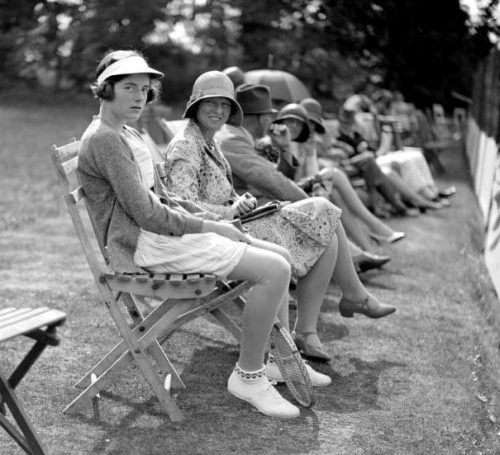
The Tournament was not held between 1915-19 due to the First World War and its aftermath. The refurbishment of the hotels, taken over by the military during the war had not been completed. From 1920 it was held annually until 1939 but after the Second World War was only revived once in 1947. Each August, a Junior Tennis Tournament was held from 1923-1939 and from 1946-9. (The right picture above shows the daughter of Winston Churchill, Sarah, at 1927's Junior tennis competition.)
In 1933 two members of the Australian Davis Cup team played and were successful in winning singles and doubles matches. A club house with squash and badminton courts was opened in 1934. Inter-county squash championship games were played here.
The club closed as income was exceeded by maintenance costs in 1951. In 1952 Noel Close and Chestnut Road were developed on this ground.
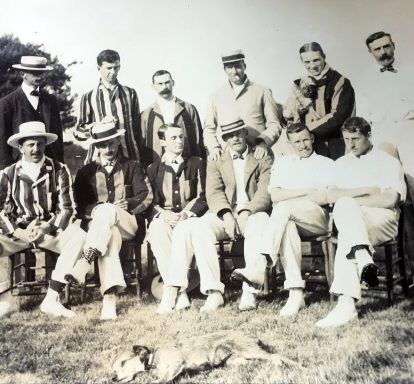
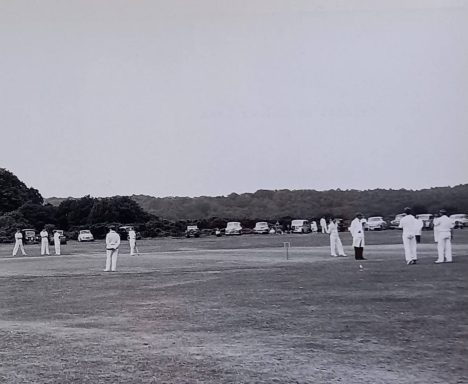
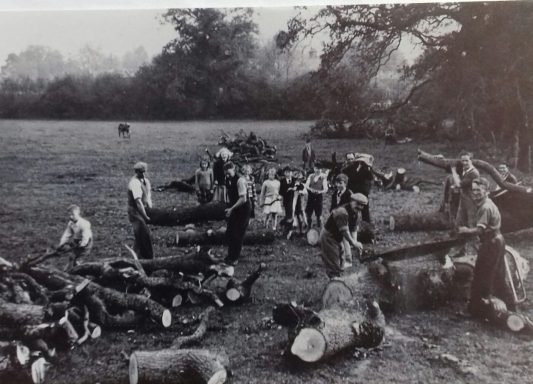
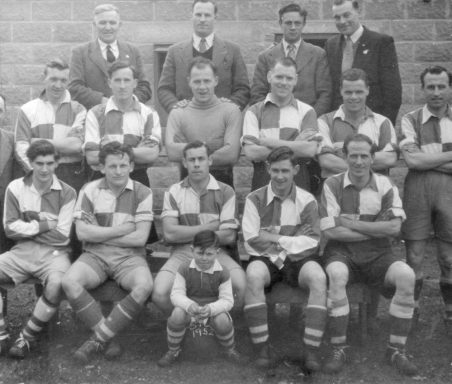
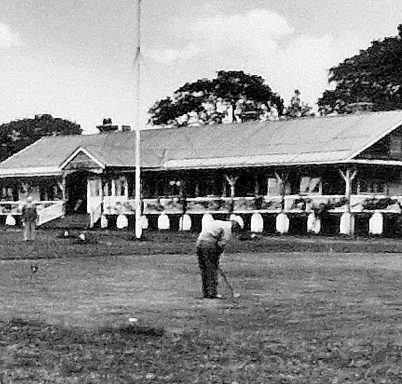
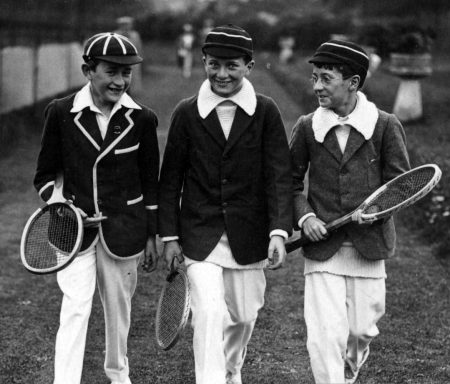
Left to right: Brockenhurst Cricket Team (part) 1903; Cricket 1950's; Clearing the football ground of trees 1953; Brockenhurst FC (part) 1952; Brokenhurst Manor Golf Clubhouse 1930's;Three boys arrive for the Junior Tennis Competition August 1925.