Preserving the history of Brockenhurst - a wonderful village at the heart of the New Forest
Historic hotels
Brockenhurst's noted hotels, and their historic past
From the 1860’s Brockenhurst became a visitor village. Many arrived by train, some by horse, and later motor car. They sought the tranquility of the New Forest but also came to pursue hobbies and sports. In 1939 there were seven hotels of various sizes in the village from the small ‘Briars’ to the ‘Balmer Lawn’ and twenty-two establishments offering ‘Bed & Breakfast’, some with full board.
Several hotels have now closed such as The Brockenhurst Hotel (now flats near the village’s Catholic Church) and The Cloud Hotel (now divided into houses at Meerut Road). But those remaining are noted for their quality of service and are a key part of Brockenhurst’s offering, to local people as well as visitors. Their stories follow below.
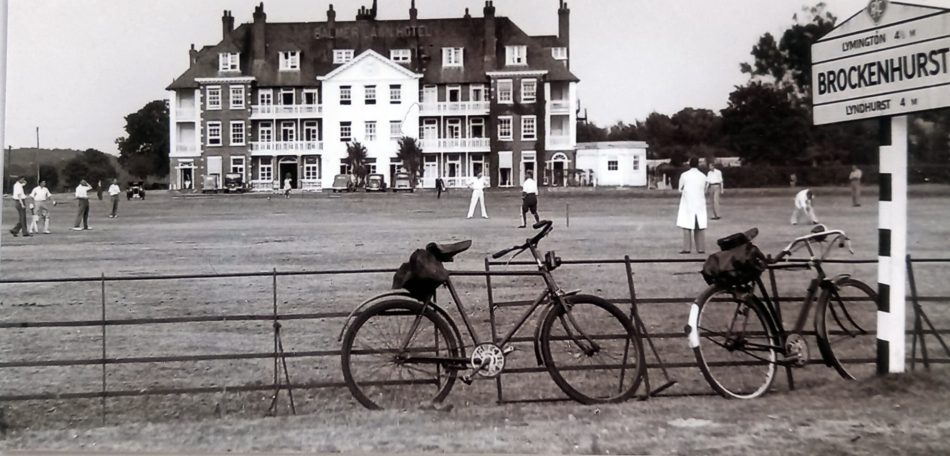
The Balmer Lawn Hotel (picture above left 1950's)
As you drive into Brockenhurst from Lyndhurst, the Balmer Lawn Hotel is prominent on the left-hand side of the road, seen across the village cricket ground.
In the 1870’s it was first built as a bungalow; ten years later the building was enlarged and turned into a hotel called The Holt. It was owned by the Ings family, who also had the tenancy of The Rose and Crown public house and hotel (The Huntsman) in Lyndhurst Road. James Wingate married their daughter and took the tenancy of The Holt enlarging it in 1900.
An attraction of The Holt Hotel was the adjacent forest golf course, leased to the Bournemouth Golf Club. There was also a horse race course at Balmer Lawn in the 1890’s and 1900’s, and race days attracted thousands. Many local hunts also set off from the front of The Holt, where the cricket ground is today. At that time the approach was directly in front of the hotel, running through where cricket is played now.
With the further extensions it was almost its present size when, in October 1914, it was requisitioned for an annex to the Lady Hardinge Indian Military Hospital, at Tile Barn Hill. Ten acres of land was enclosed for additional tented accommodation. King George V and Queen Mary visited on 14 November 1914.
When the Indian Troops were relocated to Egypt in 1916, it was taken over by the New Zealand No.1 General Hospital mainly for officers to recuperate and to treat mental illness caused by 'shell-shock' which we know as Post Traumatic Stress Disorder. In 1919 the Balmer Lawn was refurbished with 40 rooms provided with baths, ready to receive guest again.
Prince George, Duke of Kent, stayed for a weekend in July 1923 and spent time seeing the New Forest, but his car gave trouble at Lyndhurst. On taking it to the Imperial Garage, they provided him with one from their showroom to use.
Lady Honywood added the hotel to her group in the 1930’s. She would visit by landing her aeroplane on nearby ground. Mr. Cass Gilbert, the American architect of the New York Woolworth Building, died here whilst recuperating from an illness and waiting to board a ship home to the USA in 1934.
The hotel was again taken over by the military in 1939 and from September 1943 was the H.Q. of the 3rd Division of Canadian Army until April 1944. Immediately prior to D-Day it was the H.Q. for the military controlled area for the assembly and embarkation of troops and materials between the Lymington River and Southampton Water. During planning Generals Eisenhower and Montgomery paid visits to the hotel. After the war it reverted again to being a hotel.
On 19 October 1970, a painter’s blowtorch started a fire which destroyed 60% of the roof, damaging 18 rooms on the second and third floors. The present copper roof was put on as part of the rebuilding.
The hotel manager in 1983 was Andrew Coy and he distributed a leaflet to campers in Hollands’ Wood advertising the hotel bars, and the chemist and the village grocer, and this eventually led to today’s Village Shopping Guide.
Chris Wilson and his family purchased the hotel in 1997 and has made many improvements since. The hotel is reputed to have a resident ghost, a gentleman in a white coat with a stethoscope; he may have started wandering in 1914!
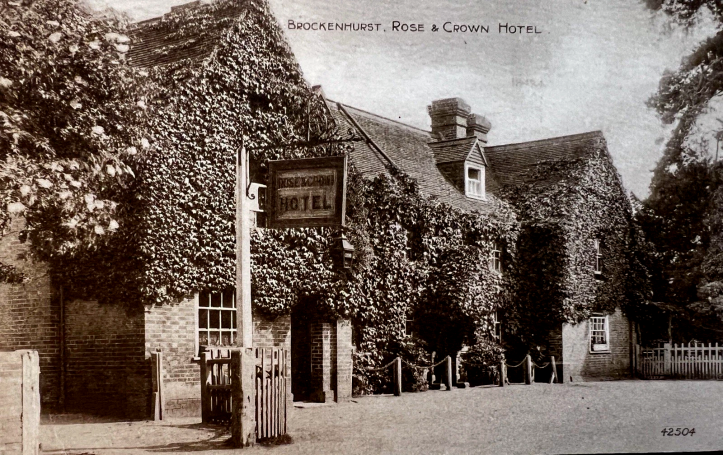
The Huntsman (formerly Rose and Crown) (picture above centre 1910)
The Rose and Crown Hotel, now The Huntsman, was a coaching inn dating from the 16th century. On old maps it is marked as ‘The Crown’ but in the 1800’s the name was changed to Rose & Crown to prevent confusion with The Crown at Lyndhurst.
Mr. & Mrs. James Ings were the landlords here in 1875 and their daughter married James Wingate who developed The Holt (Balmer Lawn Hotel).
Frank Jenvey, the Parish Clerk in 1911, recalled Brockenhurst life over his past 70 years and mentioned that the first visitors really noticed in Brockenhurst were seen at the Rose and Crown in 1864 and nicknamed ‘fly catchers’ by the locals possibly for having nets to catch insects in the forest. At that time the Rose and Crown was the only place where a horse vehicle could be hired.
The 1900 edition of ‘Rogers Guide to the New Forest’, had The Rose & Crown also advertising ‘stables for hunters and brakes and carriages for drives around the forest’ with ‘experienced drivers’.
The bar was popular with locals. Some regular customers, after having enjoyed their ‘refreshment’ would be tied on their horse, which was given a ‘tap’ on the back, and carried them home. The Rose and Crown was also a venue for many annual village dinners and suppers of local organisations such as the Fire Brigade and the annual choir and bellringers,
Prior to 1925 the Morant Estate agent regularly collected the tenants’ quarter-day rents at the Rose and Crown. For many years the brewery holding the property tenancy was Eldridge Pope of Dorchester who sold a range of ‘Huntsman’ ales. The Rose and Crown became The Huntsman in 2016, despite local protests at the loss of an historic name.
The Forest Park Hotel
The Forest Park Hotel was originally intended as a private house, called Lower Aimers, an 11-bedroom house on Rhinefield Road which had been built in 1893-4 by William Cowley who lived at nearby Ober Farm. He offered the completed house for sale, and when first bought it became the Vicarage.
On becoming Vicar in 1893 the Rev. Rupert Pain initially lived at the Setley Vicarage. However, he and his wife Annie did not find the accommodation to their liking. They were wealthy, and this allowed them (specifically Annie Pain) to purchase Lower Aimers. Mrs Pain also bought the adjacent five-and-a-half-acre field to extend the land of the Vicarage on in February 1895. This allowed the Sunday School children to enjoy their annual sports and games in the fields. A tea was provided but with a stipulation that they brought their own mug!
William Dore, who owned a hotel in Bournemouth bought Lower Aimers in 1899, after Rev. Pain unexpectedly moved to another post. He enlarged the building and opened the Forest Park Hotel, complete with stables. He also sold off most of the extra land Mrs Pain had bought, in 18 lots (but only seven sold initially). This is now Forest Park Road which surrounds the hotel and is noted for its Edwardian homes.
In 1910 the hotel came to prominence when US President Theodore Roosevelt stayed while visiting the UK for the funeral of King Edward VII. He was accompanied by Viscount Grey, the Home Secretary, who’d stayed on holiday a few years previously.
In the First World Wat, the Forest Park Hotel, like others in the village was taken over as part initially of the Lady Hardinge Hospital for wounded Indian soldiers, and later when they departed for the Middle East, it cared for New Zealand soldiers injured on the Western Front. It was particularly part of the No 1 New Zealand Hospital, specifically used for the recuperation of officers after they had been treated and made their initial recovery. The Indian flag traditionally flies as part of a group in front of the hotel today to recognise its role.
The hotel reopened in 1920, and thrived for the next two decades. It offered horses for forest rides, and some of the residents appear to have been permanent. In the Second World War unlike other local hotels which were turned to military use, the Forest Park appears to have continued as a hotel.
After the war the Forest Park changed owner several times. In 1968 it was bought by Robin Collins, who combined it with other hotels at Lyndhurst and Burley as a small group. He renovated much of the hotel, and encouraged local people in with events such as dinner dances.
However the group stumbled and in 2015 the Forest Park Hotel (and the group itself) was bankrupt. It was bought by a local developer, the stables were sold off for modern housing, the tennis court became the car park, and a swimming pool was filled in - today it is the back lawn.
In the late 2010’s, the Forest Park Hotel underwent a multi-million-pound refurbishment under different owners (including Kevin Wood and later the Coaching Inn Group who purchased in 2018) to blend traditional Tudor Renaissance architecture with contemporary luxury
The Pig (formerly Whitley Ridge)
Whitley Ridge is situated on the Beaulieu Road with an entrance opposite the Mill Lane junction, now sign posted to The Pig.
The property was built in Georgian style as a Royal Hunting Lodge prior to 1817 when it is recorded in a local ‘census’. In Victorian times the lodge was extended, creating a large and elegant home for titled gentry, with accommodation suitable for the entertainment of royalty providing stabling and garaging for the coaches.
For a short time, Whitley Ridge was tenanted, before Herbert William Fisher was in residence from 1881. Initially renting, he bought the house around 1877. Herbert Fisher was a British historian, born in Wiltshire, educated at Christ Church, Oxford and became a tutor in 1851 to the future King Edward VII. In 1863 Mr Fisher became private secretary to the Prince of Wales, his former pupil.
Fisher and his wife had seven sons and several daughters. The sons included historian Herbert Fisher (Junior) who was a noted MP and Cabinet Member; Edward Fisher, Chairman of Barclays Bank; and Admiral Sir William Wordsworth Fisher, who was Commander in Chief of the Mediterranean fleet. Among the daughters was Adeline Maria wife of the composer Ralph Vaughan Williams. Herbert Fisher (Snr) moved to Hove in Sussex but when he died in 1903 the funeral was in Brockenhurst. The King sent an official representative.
In 1889 Major Henry Charles Talbot took over Whitley Ridge house, before selling it in 1902 to Sir Edward and Mary Lingard Lucas. He was the son of Sir Thomas Lucas whose building company had constructed such places as the Royal Albert Hall, Alexandra Palace, York Railway Station and the Charing Cross Hotel, as well as several railways. Sir Edward, listed in the 1911 census as a Director of a Public Company, Lucas Electrical, also seems to have been living off his inherited wealth and extended Whitley Ridge house considerably. He also bred and sold sporting dogs (the Lucas Terrier is named after him, and first bred in Brockenhurst) and lived as a country gentleman. The census shows at least eight living-in servants (gardeners, coachmen, maids and a golf attendant).
In 1914, the house was sold to David John Carnegie, 19th Earl of Northesk. On 12 August 1918 Countess Northesk was in residence and she entertained the members of the newly formed Brockenhurst Women’s Institute to their first garden party. They moved out in 1921, but it’s thought they retained ownership, leasing briefly to Samuel Gurney-Dixon. A noted physician in England and Argentina writing several papers, he was by now a Hampshire County Councillor (later Chair, and Chair of the Education Committee). The arts centre at Priestland’s School, Lymington, is named after him.
The Hon. Lt Col. Malcolm Bowes-Lyons and his wife, The Hon. Winifred Bowes-Lyon, took the lease from 1922 to 1927. His niece Elizabeth, later the H.M. Queen and Queen Mother, stayed with them. During her visits she played golf at the Brokenhurst Manor Golf Course and tennis at the New Forest Club at the Morant Hall, (Chestnut Road is where the courts were) where her uncle and aunt were members.
The military requisitioned it during the 1939-45 war to accommodate one of the many ‘special’ units that were around the village.
After the war the property became The Whitley Ridge Hotel. In the 1960’s Brigadier John Doyle took over the hotel. He was a distinguished solder and diplomat. He marketed Whitley Ridge nationally in magazines such as ‘Country Life’ to great effect. He led the New Forest Hoteliers Association and was also on the board of London’s Victory Service Club for service personnel. John Doyle was a relative of Sir Arthur Conan Doyle, the creator of Sherlock Holmes. He collected related Holmes artefacts and memorabilia and showed them off in the hotel, advertising his ‘museum at a hotel’, through the 1970’s.
Since 2011 Whitley Ridge has been The Pig hotel and restaurant; the first of Robin Hutson OBE’s Pig group of hotels across southern England, and now owned by a multi-national hotel company.
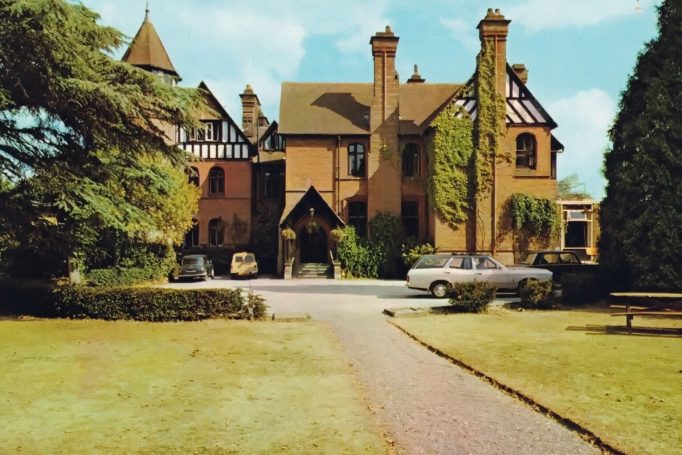
Carey's Manor (picture above right 1980's)
Carey's Manor was first built as Brockenhurst Lodge in the 17th century. It's owner, John Carey, was Riding Fortester to King Charles II who hosted the King on hunting trips to the New Forest. In the 1790's the house was taken over by the Nathaniel Bowden-Smith.
Nathaniel's son (also Nathaniel) was born at the house and became Admiral Sir Nathaniel Bowden -Smith. He was decorated early in his career after diving into the sea to save a sailor who'd been knocked overboard. Later he servied in Australia, before finishing his career in command of Sheerness Royal Navy base, and more ships than today's entire Royal Navy contains.
Another brother was Rev. Frederick Bowden-Smith, who became Rural Dean of Lyndhurst, and lived at Carey's Manor after the death of their father (Nathaniel Snr) in 1857. He demolished the original house and built a large Victorian house which is the basis of the hotel today. He often opened the grounds for local charity events, and was behind a project to build homes for workers elsewhere in Brockenhurst, known as Carey's Cottages. There is more about the Bowden-Smith's of Carey's Manor here.
Frederick's son, Herman Bowden Smith, went to Eton and Oxford and entered the colonial office serving in Egypt. He retired back to Carey's Manor where he threw himself into local life. He was a local Councillor and helped run the Institute for the Poor in Lymington. Herman also ran the Boy Scouts, was Vice-President of the Cricket Club, Vice-President of the Conservative Association, and a member of the Parochial Church Council. He also started the Brockenhurst Bowling Club which was based at Carey's, and continued after his death in 1933. The club moved to the centre of the village when the family sold the building in 1935, and it became a hotel, run by a Dutchman, Mr Builderbeck.
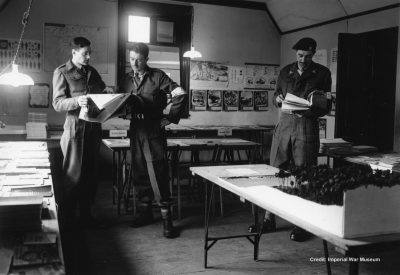
During the Second World War the Army requisitioned Carey's Manor hotel which became the Eastern Warfare School, where British Royal Marines were sent to learn jungle warfare tactics.. It also accommodated the 2nd Battalion Welsh Guards for D-Day training in 1943-4.
In recent years the hotel expanded and became part of a group with the Montagu Arms in Beaulieu and another hotel in North Wales. This included building SenSpa, a £6 million project to create a Thai inspired spa resort. More recently it was bought by an Indian private consortium, Myst Hotels and Resorts.
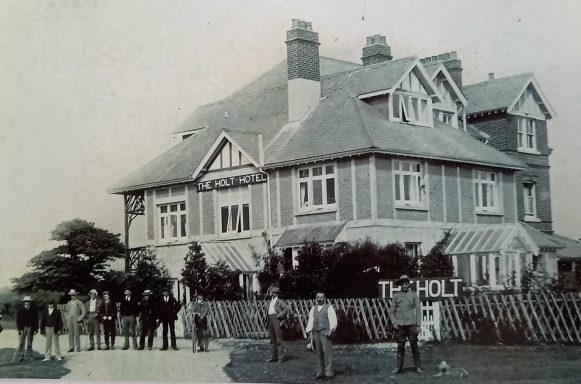
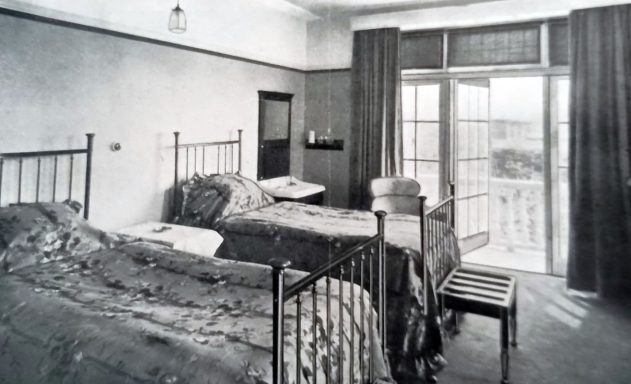
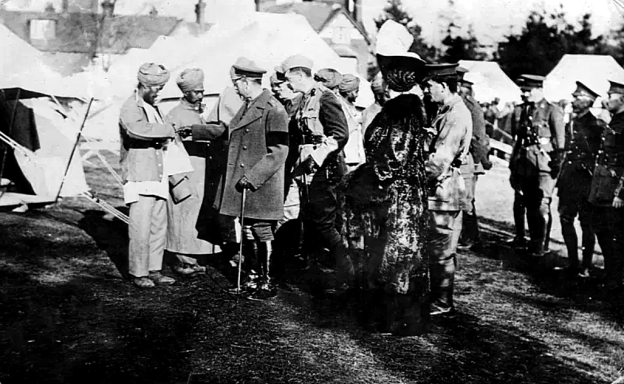
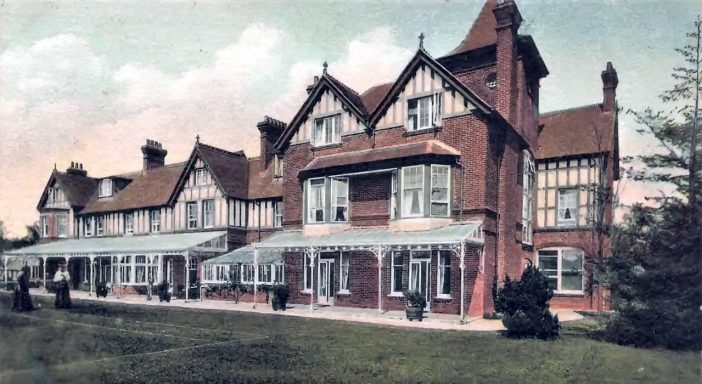
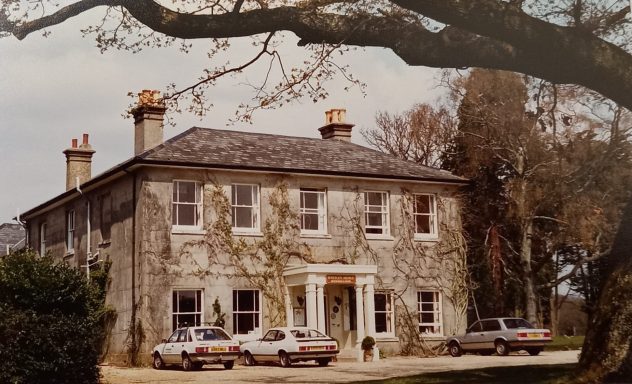
Left to right: The Holt Hotel 1900; Balmer Lawn bedroom 1930's; King George V at Forest Park Hotel 1914; Forest Park Hotel 1920's; Whitley Ridge Hotel 1975; Eastern Warfare Training School at Carey's Manor WW2.