Preserving the history of Brockenhurst - a wonderful village at the heart of the New Forest
St Saviour's Church
Brockenhurst's newer Church, built as the result of families fueding.
St Saviour’s Church owes its presence to a battle between two families. These were the Walker-Munros of Rhinefield, and the Morant family of Brokenhurst Park (as it was then spelt).
The Morant family were Lords of the Manor of Brookley, roughly one half of the village which they’d acquired as a title when they bought Brokenhurst Park 1770’s. They’d made their money running sugar cane plantations in the Caribbean. Successive generations had lived there and were patrons of nearby St Nicholas, the Parish Church, where they had a family pew. Socially they were members of the ‘county’ social set; families who owned the rural estates in the area.
Those who had accumulated their wealth from commercial enterprises were not so respected. The Walker-Munro family, possibly much wealthier, having derived their income from owning coal mines in Nottinghamshire, were considered to be ‘trade’ rather than ‘gentry’.
Land in Rhinefield was given to Mabel and Edward as a wedding present from her father, The couple planned and had built Rhinefield House (now a hotel) They styled themselves Lords of the Manor of Rhinefield – roughly the other half of the village from the Morants. This was a fiction as there was no historic ‘Lord of the Manor of Rhinefield’. Due to their background, Mrs. Morant declined to ‘Call and leave her Card’, or receive them at Brokenhurst Park, making the Walker-Munros ‘social outcasts’.
A new Church is conceived
Lt Cdr. Walker-Munro decided that if they were not good enough to mix socially then they were not going to worship at a Church where the Morants had their family pew. He would build his own chapel on the Rhinefield Estate. The vicar at that time, the Rev. Rupert Pain, on learning of the plan, approached Lt Cdr. Walker-Munro and persuaded him to build a Church in the village, on the land Walker-Munro owned opposite the Watersplash.
Building work began in 1895. It was planned considerably larger than the Parish Church, and was to be graced with a tower with a ring of eight bells
The Church was built with ‘Swanage’ Stone and Bath stone dressings in the Gothic Style and consisting of a very handsome chancel, nave of three bays and aisles, from designs by Messrs Roumaine-Walker and Bessant of London. The roof is also stone. A siding was built at the railway station just to bring the stone from Purbeck, both for the house, and the new Church.
The Church was not completed as planned; work on the project stopped when the Walker-Munro’s finances were affected by problems at the mines the family owned. With the final arch of the nave incomplete, the West end was bricked up.
The family began to use the new Church in 1905 but only at Christmas, Easter and during the summer when they were in residence. St Saviour’s was licensed for some services but was not consecrated because the then Bishop of Winchester, did not consider the necessity of having the upkeep of two Churches in such a small parish.
The Church was licensed for marriages in 1919. But Mabel Walker-Munro (her husband died in 1920) is thought to have been frustrated at not having his Church consecrated. One consequence was that Lt Cdr. Walker Munro was buried initially at the estate farm, and only moved to a family tomb (where Mabel was also interred after her death in 1934) later. The parish’s finances were very strained, keeping up two Churches, because the money that had previously been paid by Walker-Munro for the upkeep of St. Saviour’s was no longer available.
Mabel threatened that she was prepared to offer St Saviours to the Roman Catholic Church. That made the Church of England in Winchester reconsider its position. The Church was eventually consecrated and passed over to the Church authorities when the Bishop of Winchester, Dr Theodore Wood, accepted it from Mrs. Walker-Munro on 1 March 1928, the same day as the Induction of the Reverend William Haslem.
St Saviour's Church develops
In his letter to parishioners in February 1928 prior to his Institution, the Rev Haslem wrote of his impression of the challenge before him when he entered the sparsely furnished St. Saviour’s Church. He visualised a fine organ, Cathedral type choir stalls, a stone pulpit, a lectern, completion of the last bay of the nave and a tower.
Not all these things came about but in the over twenty years Rev Haslem was Vicar in Brockenhurst quite a number were achieved including the installation of electric light and an electric organ.
The Walker-Munros continued to support the Church and also used it as a form of office. Each week their agent would arrive with a leather bag full of cash, and use the Church shed to pay the wages of the manual workers on the estate.
Fire at the Church
What we have today was nearly destroyed in 1952. One December Sunday afternoon a passer-by noticed smoke coming from the Church roof. He dialled 999 and three fire engines from Brockenhurst, Lyndhurst and Lymington arrived. To their surprise when they went into the Church it was full of children, being cast for the Nativity play later in the month. In the roof they found someone had taken candles after the morning service and put them on card, before setting light in the roof space. Some lead was melted, but little other damage - the culprit was never caught.
Meanwhile the West end of the Church remained bricked up for more than half a century. In 1960, descendants of the Walker-Munro’s paid for more building work and finally the west wall was finished in stone (now leading to the Church Hall) in 1961.
This programme of renewal and addition has continued since, most recently with the building of a Church hall and kitchen in 1987, and subsequently offices and a youth facility.
You can read about the village's original Church, St Nicholas, here.
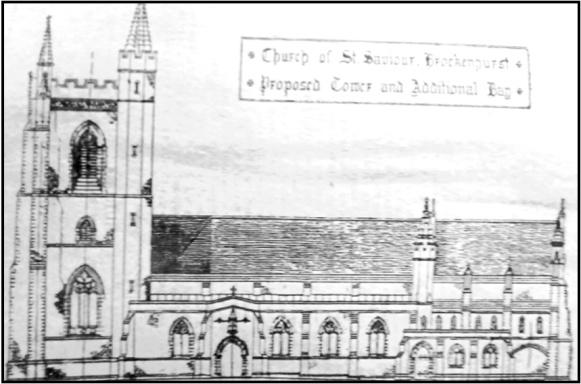
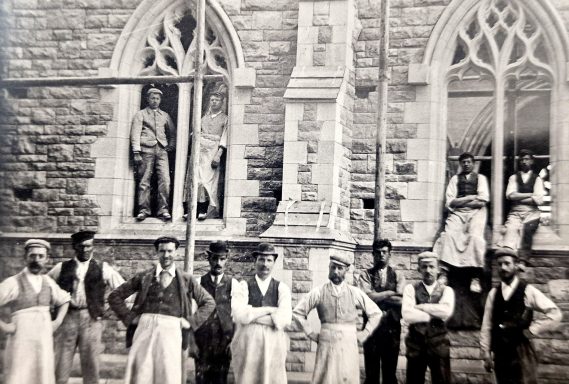
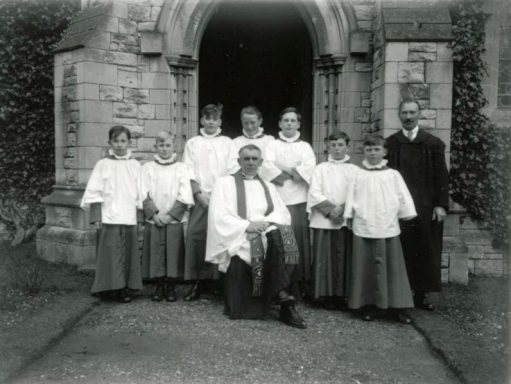
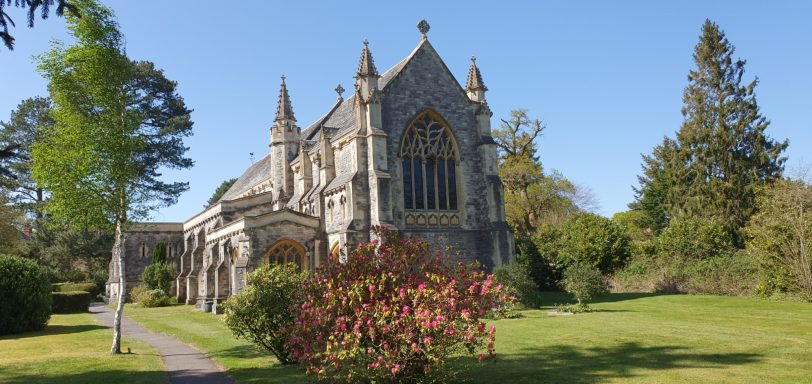
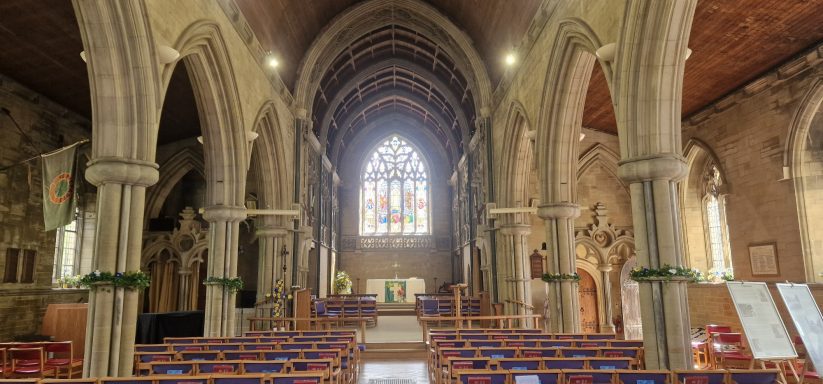
Left to right: St Saviour's Church as planned with tower; Building St Saviour's Church 1904; Rev. William Haslem and the Choir 1930's; Exterior of the Church; Inside St Saviour's