Preserving the history of Brockenhurst - a wonderful village at the heart of the New Forest
Brockenhurst Station
The arrival of the railway in the 1840's changed the village forever
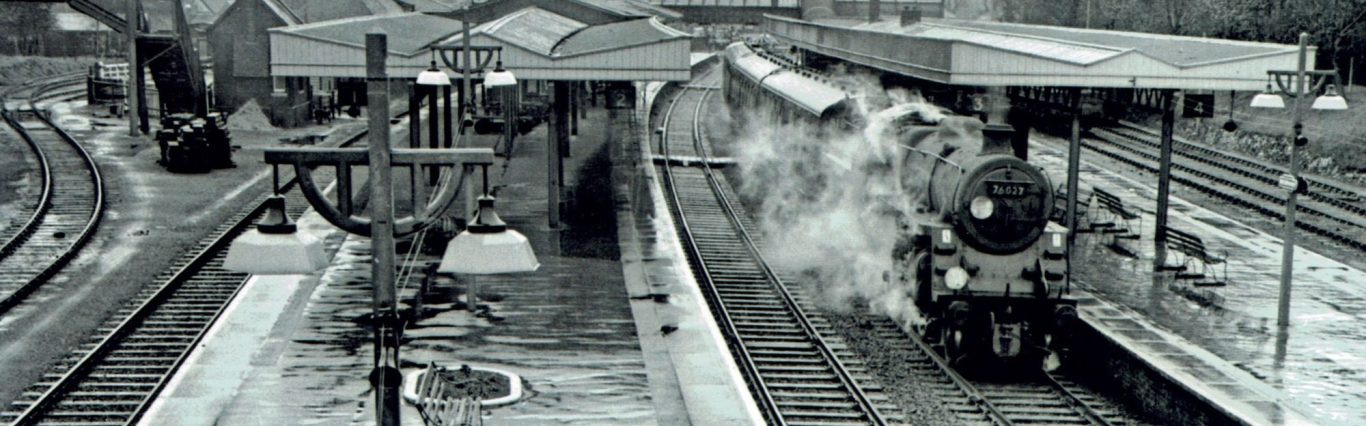
Brockenhurst Station possibly wouldn’t have been here if it wasn’t for the neighbouring village of Lyndhurst saying in the 1840’s that it didn’t want the railway, as the idea was 'a flash in the pan'. Local landowners working through the Commissioners for the Royal Woods and Forests protested against the plan to lay a rail line through the forest. It wasn't a good start.
The idea had been proposed in 1844 by a solicitor from Wimborne Minster, Charles Castleman. He planned a new railway to continue the line from London opened in 1840, to the west of Southampton. The new line would link to Dorchester, and eventually Castleman hoped, onward to Exeter. The route was approved by Parliament in July 1845. Work began in Dorset through Ringwood and Wimborne and Wareham to Dorchester immediately. It was a single track layout, at the insistence of the main stakeholder the London and South West Railway, to save money.
But even after construction was underway, the Commissioners for the Royal Woods and Forests tried to intervene and prevent the line through the New Forest. Eventually Isambard Kingdom Brunel was appointed to arbitrate, and the route through Brockenhurst was approved. The Morant family who owned much of the land both around Brockenhurst, but also Ringwood, were far-sighted and allowed access, on condition that most trains stopped in this village 'for their convenience'. Work on this part began in July 1846. The line from Ringwood to Dorchester had already been completed.
The line from Southampton to Dorchester opened on 1 June 1847, and with it, Brockenhurst Station. Ironically trains didn’t travel to London immediately as the tunnel in Southampton had collapsed, so the direct link was delayed for five weeks. The first through train from London was a mail train.
Castleman's Corkscrew
The new line became known as ‘Castleman’s Corkscrew’ as having travelled south-west from Southampton, from Brockenhurst the line went north-west via Holmsley to Ringwood, then to Wimborne, and then south to Hamworthy (for Poole), Wareham and Dorchester – the map profile resembling a corkscrew. Others called it the ‘water snake’. Bournemouth was only a village then (smaller in population than Brockenhurst) and so was considered unimportant and was by-passed.
In 1848, the Southampton and Dorchester Railway was completely taken over by the London and South West Railway. Although there were disagreements, Castleman eventually became the Chairman of the L&SWR from 1873 to 1875. By this time the entire line had been doubled, so trains could travel freely in either direction and pass each other.
Brockenhurst Station had grown in importance. A key part of this was the opening of the Lymington Branch Line in 1858. For a time this station was called Brockenhurst Junction, to reflect its new status.
Other reasons have also been put forward for the growth of this station. One is that the gradient between London and Brockenhurst was gentler than that to the west, and so trains had to be divided here to allow the relatively weak engines to continue up the steeper slopes. That meant the construction of sidings and other facilities. Another aspect is that the Walker-Munro family who built nearby Rhinefield House and St Saviour’s Church wanted to use Purbeck stone, so they paid for the sidings and goods yard to be built to allow delivery. Later, it is said, the Walker-Munro's kept a private rail carriage in the sidings, which was attached to London-bound trains when they wished to travel.
The Direct rail line to Dorchester via Bournemouth
In the meantime, Christchurch and Bournemouth had not so much grown as boomed. There was an attempt to link them through a branch line south of Ringwood, but it was clear a more direct route was needed. This came in 1888, when a new route from Brockenhurst, through Christchurch, Bournemouth and Poole joined the existing line at Hamworthy. The Ringwood line was downgraded to a second branch line from Brockenhurst in the 1890’s. Most of the buildings such as the ticket office and waiting rooms date from 1888.
Wartime
The First World War played a key part in the history of this station. Brockenhurst was chosen by both the Indian and New Zealand armies for hospitals to treat soldiers injured on the French and Belgian battlefields. The air was reckoned to be good, and the proximity of the coast, as well as good transport links made the village ideal. From 1914, the Indian Army created a hospital, initially in tents, then corrugated iron buildings. However, they found the weather cold and dismal and in 1916 moved elsewhere. Some 3,000 Indian soldiers were treated locally, and three of those who died are also buried at nearby St Nicholas Church in an official war grave cemetery. You can read about the First World War and Brockenhurst here.
As the Indian Hospital closed, a new large military hospital, the No 1 New Zealand General Hospital, was opened about a mile from this station in June 1916. It treated some 21,000 soldiers by the end of the war. Many doctors and nurses travelled here from New Zealand to care for patients. Sadly 93 died here and are also buried locally in an official war grave cemetery at St Nicholas Church.
In 1923 the London and South Western Railway became the Southern Railway – and remained this until nationalisation in 1948. The station was extended again, and modernised with electric light, in 1936. The newer buildings, such as the waiting room on platform 3/4 have curved walls and other details reflecting architecture of the period, championed by Sir Herbert Walker, General Manager of Southern Railway, who was a keen supporter of modernisation and the Art Deco movement.
During the Second World War, Brockenhurst was again important, as a base for military training and various military Headquarters. There were also large Prisoner of War camps nearby, and German and Italian soldiers arrived through the station for their internment. Thousands of Allied soldiers, lorries and mechanised vehicles gathered in and around the village in the run-up to D-Day, and the Brockenhurst rail sidings were extended to take pressure off Eastleigh further up the track, and to spread the risk in case of German bombing. Many of the great military commanders and politicians passed through the station for meetings and planning conferences in the village.
Probably the saddest and most dramtic incident at the station occurred in 1946, when the gas boiler in the tearoom on Platform 1/2 exploded. The room was destroyed, and bricks and glass hit the London-bound train outside. The front carriages and engine were simply decoupled and continued to London arriving 25 minutes late. Tragically the tearoom attendant was killed in the explosion, and several on the platform and the train were taken to Lymington Hospital for treatment. The incident received national coverage.
Decline and cuts
After the war, the amount of goods being carried by rail was falling and being transferred to the roads. In the 1960’s the goods sidings were taken up, replaced by car parking. The former goods shed and loading bay survives today as an Italian restaurant in the main car park opposite the ticket office.
Much of the original ‘Castleman’ rail line, from Brockenhurst through Ringwood and Wimborne was finally closed in 1964, as a result of the cuts. The line was lifted in 1965 and today parts of it form the local road network on the road between Brockenhurst and Burley. The Holmsley Tea Rooms on that route are in fact the old rail station. In the late 1960's the railway siding was lifted and today is the main station car park. The goods shed was converted to a restaurant.
In the meantime, the mainline was electrified. Southern Railway had begun its third rail electrification system (rather than overhead wires) in the 1920’s, but it didn’t reach Brockenhurst and then Bournemouth until 1967. (The picture at the top was taken in 1966.) With its introduction the last steam trains ran on the line. In the same year the most famous regular train – the ‘Bournemouth Belle’ – was withdrawn as a regular service. However new services arrived such as Motorail, where cars could be transported by trains, with drivers and passengers in an accompanying carriage from Scotland. However it only lasted two or three years to 1980.
In 2009, Brockenhurst Station was named the Best Medium Size Station in the national ‘Station of the Year’ Awards. In 2015, Network Rail embarked on a major scheme to update Brockenhurst Station. It was suffering in part through lack of maintenance, but also the facilities needed modernising especially to improve access to trains for people with mobility issues. New stairs, walkways, lifts, and other features were built in a £4.5 million pound project. One loss was the traverser bridge, the last on British Railways, which would be swung out near the ticket office to allow stair free access over the rail line to platforms 1 and 2. In recent years, more than one million passengers have got on or off a train here annually. The Friends of Brockenhurst Station was officially launched in 2019. This award winning group supports the station ranging from flower displays, research, and helping link the rail to the community.
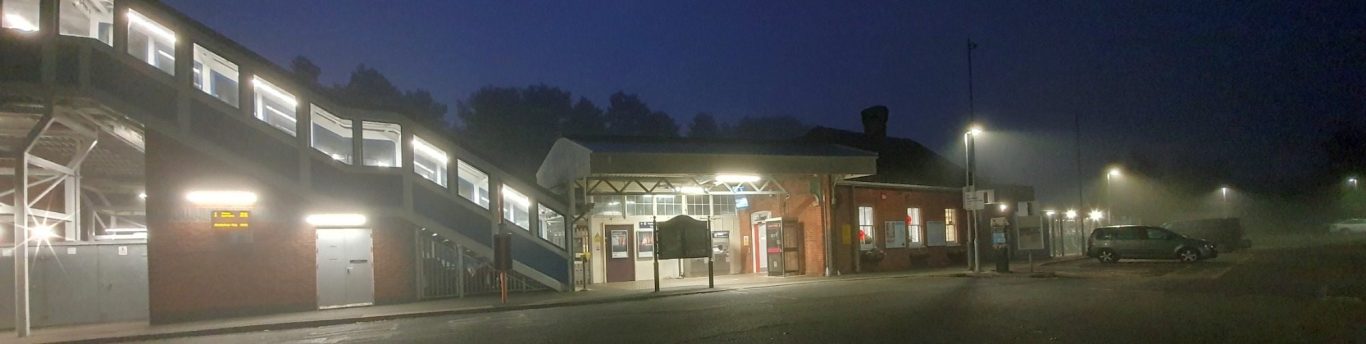
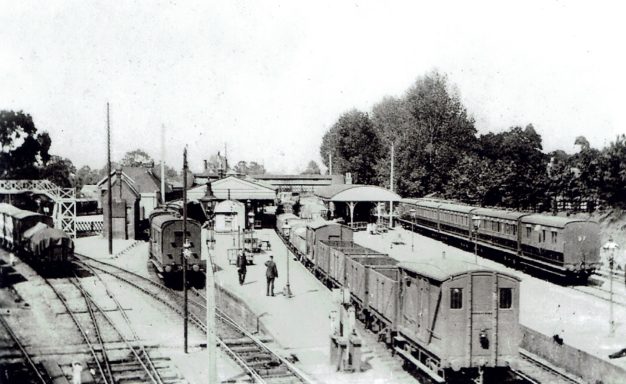
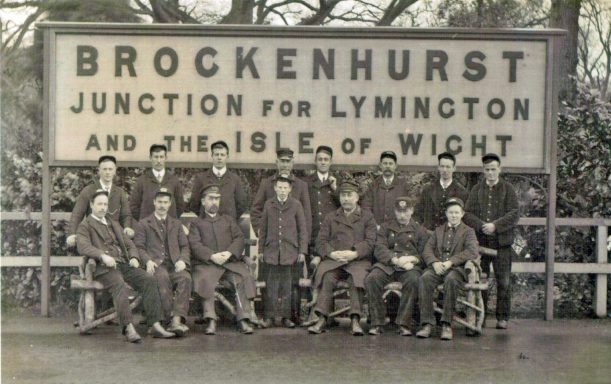
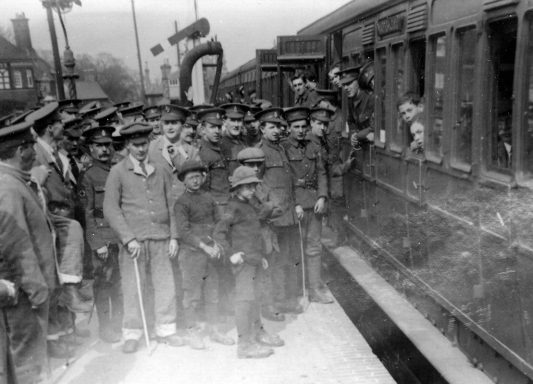
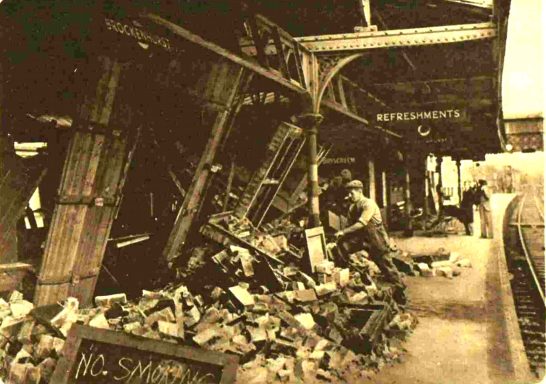
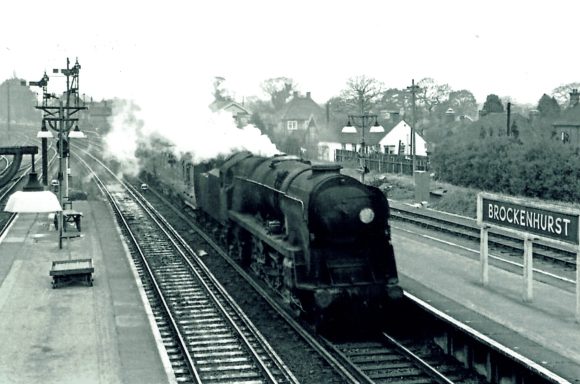
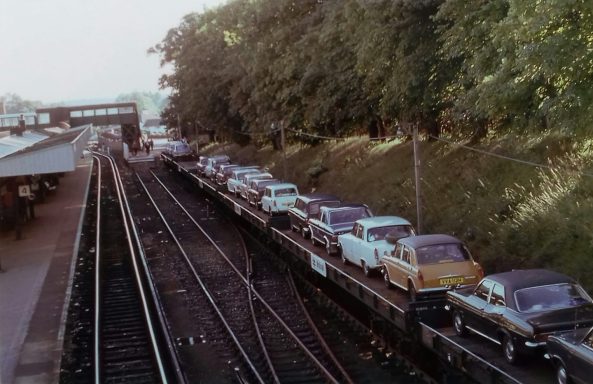
Left to right: Brockenhurst Station 1870's; Station staff 1888; British soldiers off to war 1915; Platform explosion 1946; Steam in the 1960's; Motorail waiting to drive off in Brockenhurst