Preserving the past and heritage of this wonderful village at the heart of the New Forest
Margaret Plumbly's Memoirs of 1880-1930
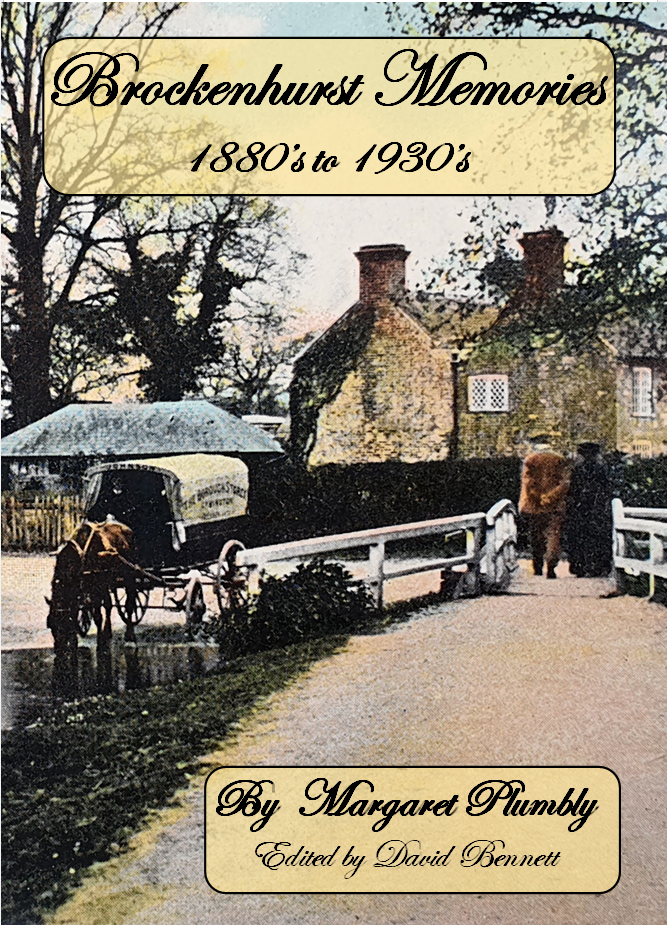
Margaret Plumbly was born in Brockenhurst in 1889, to a family who lived in Wide Lane (now Sway Road).
She was a teacher at the primary school, and a nursing volunteer in the First World War, and otherwise active in the village and beyond. Margaret married Ernest Plumbly in 1929. Both she and Ernest had been previously widowed.
Ernest ran a building company in Brookley Road, later run by his son, and they built many houses in Brockenhurst. Margaret and Ernest lived in Partridge Road. Ernest passed away in 1960, and Margaret died in 1977.
In the 1950's Margaret wrote down the memories of her own father George Spracklen (who'd died in 1907) and her husband. They tell of Brockenhurst from around 1880, when much was undeveloped and the modern services we take for granted today hardly existed. She described shops, places to meet and be entertained with dances and concerts, the school, and the Church.
This has now been edited, with some explanatory notes added, and you can download a free copy of the illustrated book (.pdf) here: Margaret Plumbly's Brockenhurst Memories 1880's -1930's.
Extracts from the book:
POST AND MAIL
'The Post Office was first at the shop over the level crossing (Editor: Corner of Mill Lane and Lymington Road), afterwards owned by Miss Butt. There was one delivery of mail a day and one permanent postman.
The morning round was by way of the Park (Brokenhurst Park on Mill Lane) to Setley, then across to Hincheslea and down the Weirs to Waters Green and the Lyndhurst Road. The houses at Balmer Lawn and those past the school on the Sway Road were outside the delivery area and people living there had to fetch their own letters.
People living along the Lymington Road could hand any late letters to the driver of the mail van on payment of one penny, the driver blowing a horn to give notice of his approach. The letters were taken to Lymington for sorting and then brought back to Brockenhurst for dispatch by the up and down mail trains. The mail was carried in an ordinary two-wheeler cart drawn by a Forest pony.
The Park and Hincheslea had their own private letter bags which were locked at the Post Office and delivered by the postman. For this special service a charge of £1 a year was made.
Miss Butt’s shop is now demolished and dwelling houses have been built there – the Lymington side of the railway gates at the corner of the road to Beaulieu.'
FIRE BRIGADE AND BELL
'At the Annual Parish Meeting after Mr. Pope’s disastrous fire (1909), the question was raised as to having fire hydrants and forming a volunteer Fire Brigade. There were no hydrants in the village and no means of checking or coping with a fire. After two years of discussion and correspondence, 24 hydrants were fixed. It was then decided that the provision of fire appliances and the forming of a Fire Brigade should be proceeded with.
The 1911 Coronation Committee, under the chairmanship of Rev. Chambers, suggested that a Fire Bell be installed, as a permanent Coronation memorial. This was erected in 1912 in the garden of Mr. Short at Rosetta Cottage. A brass plate was fixed to the post, inscribed: ‘This bell was provided by the parishioners of Brockenhurst as a memorial of the coronation of King George V 1910’.
Mr. F.W. Chalk offered some premises in Brookley Road for the use of the fire appliance and our first Fire Station was at the spot where Mr. Reg Chalk now has his fish shop (Now the Parish Council office). Mr. G.W. Chalk, his grandfather, was one of our first firemen. The first “fire engine” was a handcart, then came a horse-drawn one.
The majority of the firemen lived in Brookley Road, which was as well, as there were then no private phones and very few cars. Other fireman were Mr. Ken Martin’s father at the pharmacy, Mr. Arthur Steven’s father at Institute House, Edwin Holtom at the butchers, his brother, Spencer at the other end of the row, now Ormiston, Knight & Payne, Harry Brown at the Jewellers, my husband Mr. E.H. Plumbly just opposite at Wyndham, Phil Russen at Greatham House, Rory Short at Rosetta Cottage and Mr. Lyle, the first Captain, at Lloyd’s Bank.
In July 1913 it was decided to test the fire bell and it was accordingly rung by Mr. John Morant, then five years old. Another brass plate was put on the post and reads; “The fire bell was rung for the first time by John Morant (the present Lord of the Manor) aged 5 years on July 23rd 1913”.
The Morant Trustees afterwards presented the Brigade with brass helmets.'